Art
Learning to look.
This space is for learning, not teaching. I share artists, ideas, and works that move me, people like Toulouse-Lautrec, and what I discover as I spend time with their art. It’s an ongoing conversation with beauty, history, and human expression.

Henri de Toulouse-Lautrec
Seven works, from the spectacle of Parisian nightlife to quieter moments behind the scenes.
The reading notes below paraphrase the credited museum, scholarly, and catalogue sources. Follow each source for its full interpretation. Image credits appear beneath each work.

01 / HENRI DE TOULOUSE-LAUTREC
Rousse (La Toilette)
The Musée d’Orsay connects the high viewpoint and unposed figure to Degas’s scenes of women washing. Lautrec brings us close to an ordinary private moment, with the woman’s back anchoring the composition. The museum distinguishes his approach through the humanity of his observation. The room’s wicker chairs also suggest his own studio as the setting.
Interpretation: Musée d’Orsay, collection commentary via Google Arts & Culture ↗
Musée d’Orsay, Paris. Photograph: Didier Descouens, via Wikimedia Commons; resized site reproduction. Image source ↗ · CC BY-SA 4.0 ↗
View full size ↗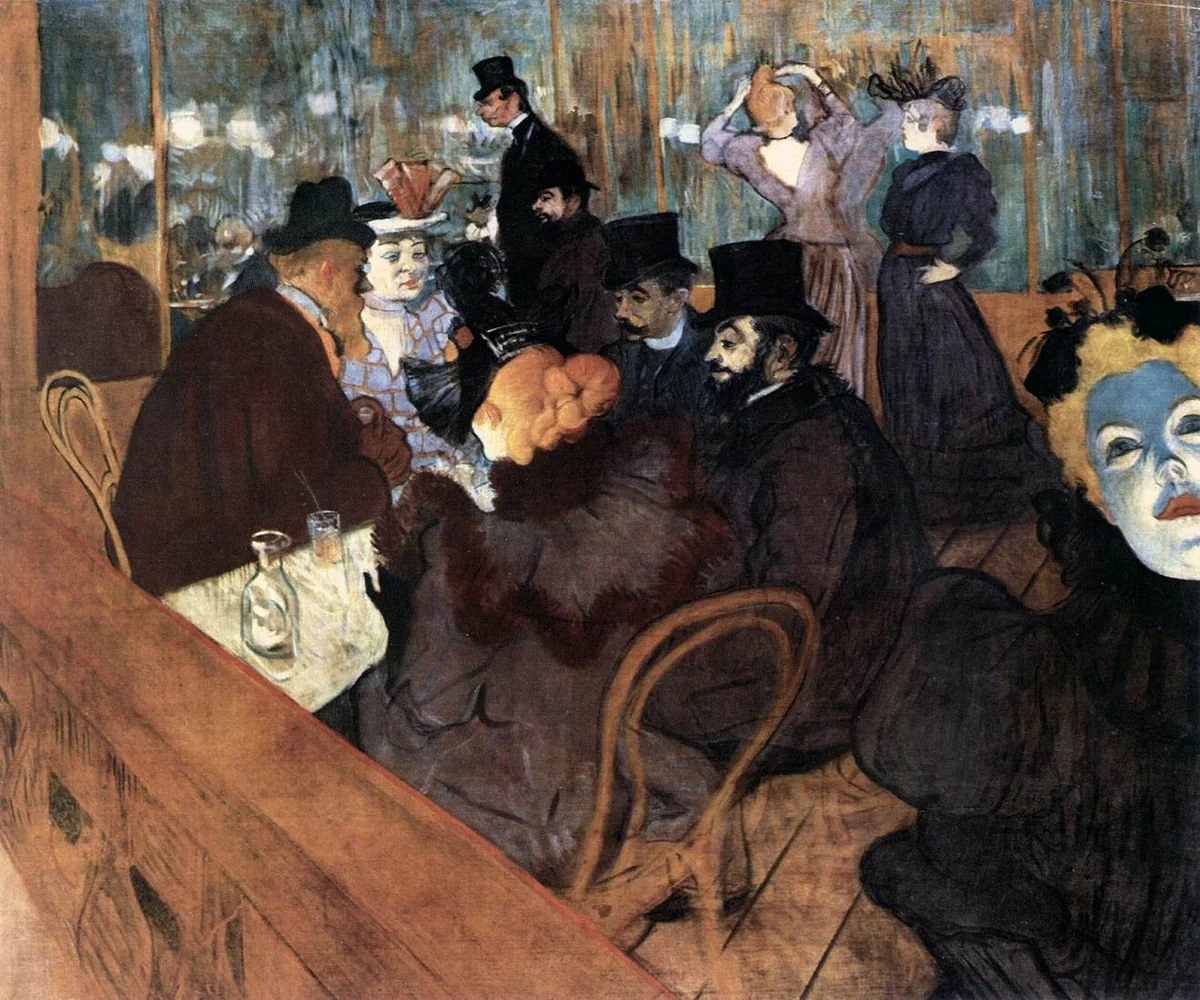
02 / HENRI DE TOULOUSE-LAUTREC
At the Moulin Rouge
The Art Institute of Chicago identifies this as a group portrait of Lautrec’s own circle. The dancers Jane Avril and La Macarona sit with his friends; Lautrec appears in the background beside his taller cousin. At the right, May Milton’s startling green face shows his fascination with the nightclub’s electric lighting. Artificial glare becomes part of the painting’s expressive language.
Interpretation: Art Institute of Chicago, collection commentary ↗
Art Institute of Chicago, Helen Birch Bartlett Memorial Collection. Public-domain artwork. Image source ↗
View full size ↗03 / HENRI DE TOULOUSE-LAUTREC
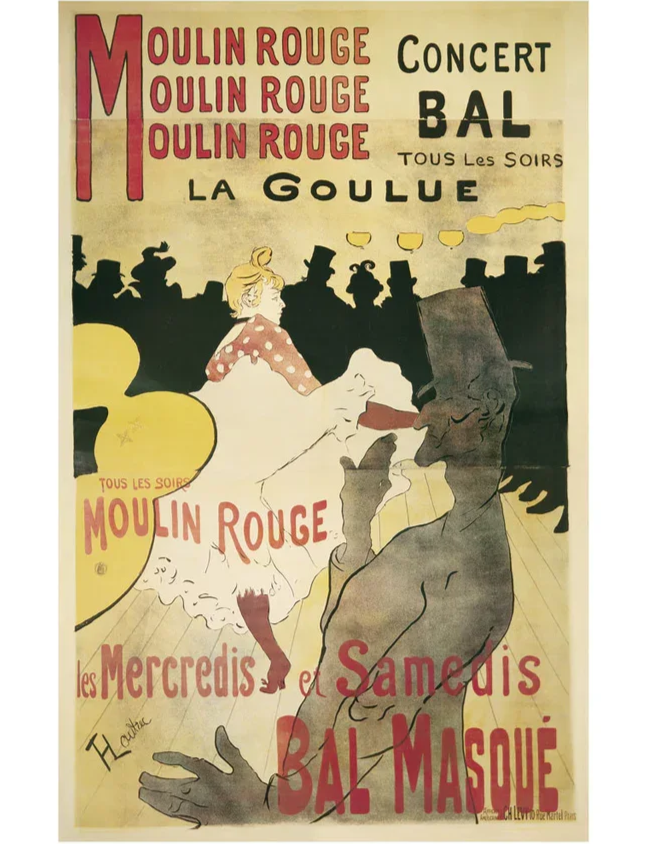
Moulin Rouge: La Goulue
The Metropolitan Museum of Art describes this commission as the breakthrough that launched Lautrec’s career as a poster designer. It directs attention to the Moulin Rouge’s star performers: La Goulue and Valentin le Désossé. Their distinctive shapes make the performers recognizable at a glance, turning an advertisement into a portrait of the venue’s personality.
Interpretation: The Metropolitan Museum of Art, collection commentary ↗
Image: The Metropolitan Museum of Art, Harris Brisbane Dick Fund, 1932, accession 32.88.12. Public domain. Image source ↗
View full size ↗04 / HENRI DE TOULOUSE-LAUTREC
Divan Japonais
The Metropolitan Museum of Art points out a reversal: Jane Avril, usually the performer, appears here as a member of the audience beside writer Édouard Dujardin. Onstage, Yvette Guilbert’s head is outside the frame, yet her long black gloves make her identifiable. Lautrec lets a gesture, a silhouette, and a familiar costume carry the identity of a celebrity.
Interpretation: The Metropolitan Museum of Art, collection commentary ↗
Image: The Metropolitan Museum of Art, Bequest of Clifford A. Furst, 1958, accession 58.621.17. Public domain. Image source ↗
View full size ↗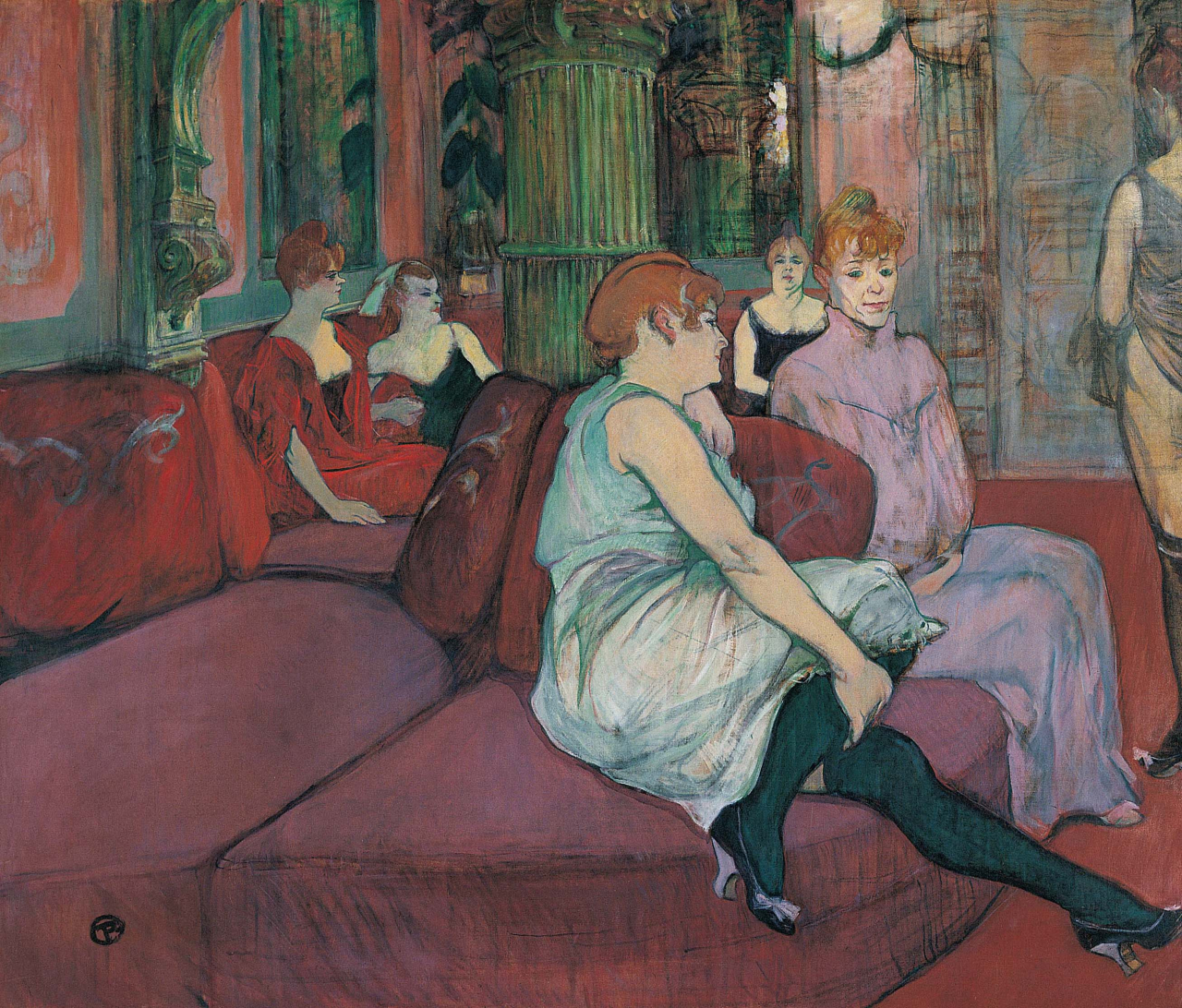
05 / HENRI DE TOULOUSE-LAUTREC
At the Salon on Rue des Moulins
The Musée Toulouse-Lautrec draws attention to the diagonal made by the foreground woman’s leg and arm, and to the vacant red sofa below it. These spaces reinforce the sense of waiting. The seated women neither converse nor meet one another’s eyes, yet Lautrec distinguishes their faces individually. The museum’s reading emphasizes boredom and a heavy atmosphere within the richly furnished room.
Interpretation: Musée Toulouse-Lautrec, collection commentary ↗
Musée Toulouse-Lautrec, Albi; gift of Countess Adèle de Toulouse-Lautrec, 1922. Image: © F. Pons, mTL Albi. Image source ↗
View full size ↗
06 / HENRI DE TOULOUSE-LAUTREC
Rue des Moulins (The Medical Inspection)
Art historian Mary Hunter examines this scene through the experience of waiting for a compulsory medical examination. She reads the older woman’s posture and fatigue as signs of time endured, while the setting places the women between their identities as individuals, workers, and patients. Her analysis makes the exposed bodies inseparable from the institutions that monitored them. It is an uncomfortable image of vulnerability and control.
Interpretation: Mary Hunter, “The Waiting Time of Prostitution,” Art History 42:1 (2019), pp. 68–93 ↗
Image: National Gallery of Art, Washington, Chester Dale Collection, accession 1963.10.69. Public domain. Image source ↗
View full size ↗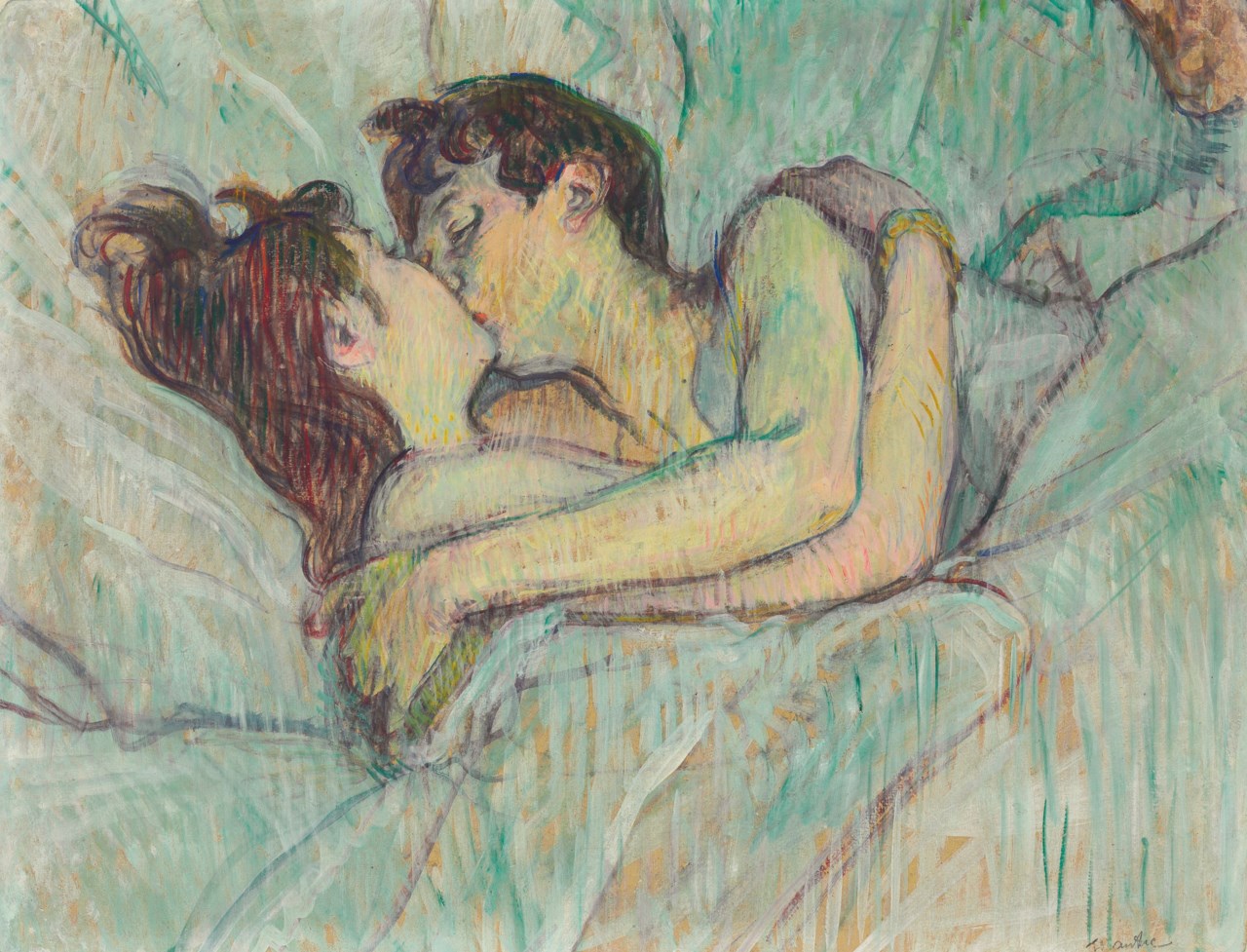
07 / HENRI DE TOULOUSE-LAUTREC
In Bed: The Kiss
Au lit: Le baiser
Christie’s catalogue interprets the intertwined arms and enclosing bedclothes as a self-contained space of intimacy. This is one of four paintings of female couples in bed that Lautrec made in 1892. The focus is the women’s connection with each other, within a setting where private affection existed alongside commercial sex.
Intimacy and censorship
According to the catalogue, this painting and another titled Au lit were exhibited in Paris in 1892. After a complaint, police demanded that one be removed. The account does not establish which painting prompted the demand. The episode reveals the resistance that these public depictions of female intimacy encountered.
Interpretation: Christie’s, Au lit: Le baiser, lot essay and exhibition history (2015) ↗
Private collection. Image: Christie’s, 2015 lot 16A; public-domain artwork. This version measures 45.5 × 58.5 cm. Image source ↗
View full size ↗This space is for learning, not teaching.
I share artists, ideas, and works that move me—people like Toulouse-Lautrec—and what I discover as I spend time with their art.
It’s an ongoing conversation with beauty, history, and human expression.